
What Is A5 Wagyu and Why It Still Sits Above Everything Else
The first time you encounter A5 Wagyu on a menu, the price gives you pause.
The second time, you understand it.
A5 Wagyu is a category of Japanese beef so distinct in texture and flavour that comparing it to conventional beef requires a different vocabulary. The fat behaves differently. The bite feels different. The finish lingers in a way that well-sourced steaks typically do not.
Before you sit down to order it, understanding what the grade actually means changes everything about the experience.
What Is A5 Wagyu
A5 Wagyu is the highest achievable grade within Japan's national beef grading system, administered by the Japan Meat Grading Association. The grade is not a marketing label. It is a regulated certification given to cattle that score at the absolute ceiling across multiple quality criteria.
The name breaks down into two components. The letter refers to yield grade, meaning the percentage of usable meat relative to the carcass weight. Grade A represents the highest yield, above 72 percent. The number refers to meat quality, scored on a scale from one to five across four separate criteria. A five is the maximum. A5 Wagyu carries both.
What this means in practical terms:
The fat distribution reaches a marbling score of 8 to 12 on the BMS (Beef Marbling Standard) scale.
The meat colour and brightness fall within the highest designated range.
The texture and firmness are evaluated and must meet Grade 5 standards.
The fat colour, lustre, and quality are assessed separately and must also score at the top tier.
All four criteria must achieve a score of five for the beef to be classified A5. A single criterion scoring four drops the entire designation. This is why genuine A5 Wagyu japanese beef represents a small fraction of total Japanese beef production.
Why A5 Wagyu Is Considered Premium Japanese Beef
A5 Wagyu is genuinely unlike anything produced outside Japan's controlled breeding programs, and it’s important to know its distinction.
Marbling and Texture
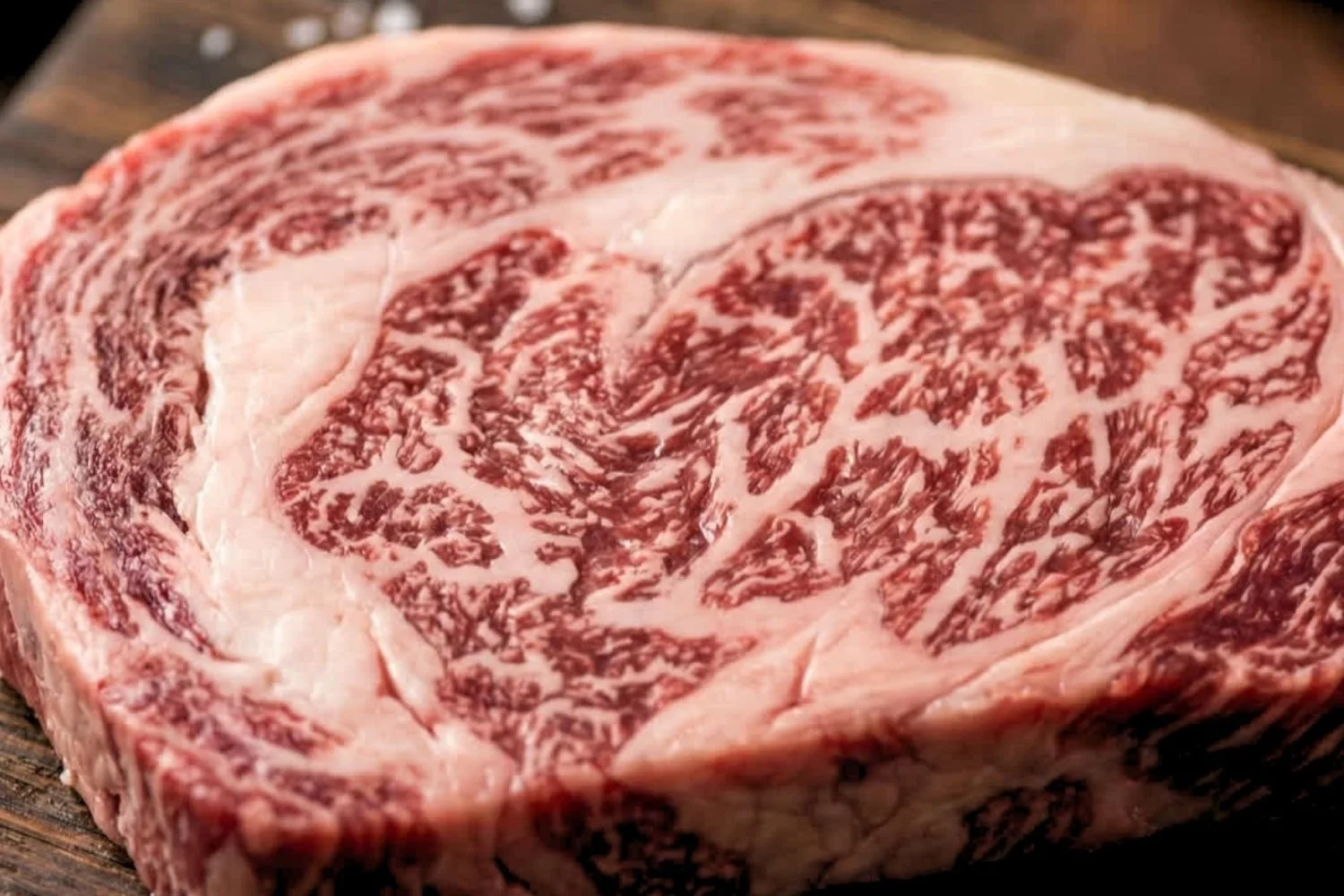
The marbling in A5 Wagyu is unlike the fat distribution found in conventional beef. In standard cuts, fat sits between muscle groups. In A5 Wagyu, the fat runs through the muscle fibres themselves, a phenomenon known as intramuscular fat. Under heat, it dissolves almost immediately, coating the palate before the protein registers.
Flavor and Fat Quality
The flavour profile of A5 Wagyu is built on oleic acid, the same monounsaturated fatty acid found in high-quality olive oil. Wagyu cattle accumulate it in high concentrations compared to other breeds. The result is a richness that reads as buttery, sweet, and faintly nutty, with very little of the iron-forward, gamey quality associated with conventional beef.
Japanese Wagyu Grading System
The grading process is conducted by certified assessors at the time of slaughter. It is independent, standardised, and not subject to self-reporting by producers. Every carcass is evaluated individually.
The four quality criteria assessed are:
Beef Marbling Standard (BMS): scored 1 to 12, with A5 requiring a minimum of 8.
Beef Colour Standard (BCS): evaluated against a reference chart; the highest scores reflect a bright, vibrant red.
Beef Firmness and Texture: assessed visually and by touch; top scores indicate fine grain and firm, resilient texture.
Beef Fat Standard (BFS): fat colour and quality evaluated against a reference chart; top grades show a creamy white with high lustre.
Miyazaki A5 Wagyu, sourced from Miyazaki Prefecture on the island of Kyushu, is among the most recognised regional designations internationally. The cattle are raised on a specific diet over an extended period, with the breeding lineage controlled across generations.
A5 Wagyu vs Regular Wagyu
The distinction between A5 Wagyu vs regular Wagyu is not simply a matter of degree. The eating experience occupies a different category.
A few comparisons that clarify the gap:
American Wagyu is typically a crossbreed between Wagyu and Angus cattle. The marbling is good. The lineage is mixed. It does not qualify for the Japanese grading system.
A3 Japanese Wagyu scores a maximum BMS of 5. Noticeably rich, but the intramuscular fat distribution is less dense than A5.
A5 Wagyu scores BMS 8 to 12. The fat is so thoroughly distributed through the muscle that the cut appears almost white in cross-section.
The price difference between A3 and A5 is significant. The experiential difference justifies it for anyone who has had both.
Is A5 Wagyu Worth It at a Restaurant
The question of whether A5 Wagyu is worth it at a restaurant depends almost entirely on context. The beef itself is a controlled product. What varies is the kitchen's understanding of how to handle it.
A few markers of a kitchen that takes A5 Wagyu seriously:
Portions are small and intentional. Two to four pieces in a plated format is standard.
The preparation respects the fat. Extreme heat destroys what makes A5 distinct. Skilled kitchens apply heat briefly and with precision.
The accompaniments are restrained. A5 Wagyu does not need heavy saucing. The beef carries the dish on its own.
The sourcing is specific. A kitchen that cannot tell you the regional origin of their Wagyu is worth questioning.
At a restaurant where these conditions are met, A5 Wagyu is worth it. The a5 wagyu price at restaurant level reflects not just the raw material cost but the handling, portioning, and context of the experience.
How A5 Wagyu Is Served in Japanese Restaurants
In Japan, A5 Wagyu appears across multiple formats, each designed to let the fat and texture register differently. In a premium sushi or omakase context, the preparation is typically minimalist. The beef does the work.
A5 Wagyu Tataki
Tataki refers to a preparation where the beef is seared briefly at very high heat on the exterior while remaining raw or barely warmed at the centre. For A5 Wagyu, this method is deliberate. The char on the surface introduces a faint bitterness that cuts through the richness of the fat. The interior stays soft, the fat barely warmed.
A5 Wagyu Nigiri
Served over sushi rice as nigiri, A5 Wagyu becomes something different again. The warmth of the rice begins to soften the fat from below while the beef sits cool above. By the time the piece reaches the palate, the fat has already started to release.
At RYU, the A5 Wagyu plate arrives as four pieces served with sukiyaki broth, green onions, benitade, and fried onions. The sukiyaki broth introduces a savoury-sweet depth that anchors the richness without competing with it. The benitade, a Japanese herb with a mild pepperiness, provides a counterpoint that keeps the palate alert between pieces.
A5 Wagyu Omakase
In an omakase context, A5 Wagyu functions as a centrepiece course. The chef controls the sequence, and A5 Wagyu typically arrives after lighter preparations, nigiri, sashimi, when the palate is calibrated and ready for something more substantial.
When to Order A5 Wagyu at a Japanese Restaurant
A5 Wagyu is a considered order. The richness is real and cumulative. A few practical points:
Order it mid-meal, after lighter courses have settled. Starting with A5 Wagyu flattens the palate for everything that follows.
Pair it with something acidic or lightly bitter. A clean sake, a citrus-forward accompaniment, or a ponzu element cuts the fat and restores clarity.
Resist the instinct to order more pieces than the portion suggests. Two to four pieces is a complete experience. More becomes counterproductive.
Ask what preparation the kitchen recommends. In a premium wagyu sushi restaurant, the chef's preference usually reflects the format that best suits that day's cut.
The premium wagyu sushi restaurant setting is the right environment for A5 Wagyu precisely because the kitchen is oriented around the logic of restraint. The omission of excess is the whole philosophy.
FAQs About A5 Wagyu
What does A5 Wagyu mean?
A5 Wagyu is the highest grade in Japan's national beef grading system. The A refers to yield grade, indicating the highest percentage of usable meat. The 5 refers to meat quality, the top score across marbling, colour, texture, and fat quality.
What makes A5 Wagyu special?
The intramuscular fat distribution in A5 Wagyu is unlike any other beef grade. The fat runs through the muscle fibres at a density that produces a texture and flavour profile unachievable through conventional breeding or farming methods.
How is A5 Wagyu served at a Japanese restaurant?
A5 Wagyu is typically served in small portions, two to six pieces depending on the format. Common preparations include tataki, nigiri, and as part of a premium omakase sequence. At RYU, it is served as a four-piece plate with sukiyaki broth, green onions, benitade, and fried onions.
Is A5 Wagyu worth the price at a restaurant?
In a kitchen that sources correctly and handles the beef with precision, yes. The quality difference between A5 and lower-graded beef is substantive and immediately perceptible. The a5 wagyu price at restaurant level also reflects the logistics of sourcing certified Japanese beef.
Where can I try A5 Wagyu in Montreal?
RYU serves A5 Wagyu at both the Peel Street and Griffintown locations. Reservations are available online through the RYU website.
A5 Wagyu in Montreal: Where the Grade Meets the Setting
RYU serves A5 Wagyu across two Montreal locations, Peel in downtown and Griffintown, in a setting designed to match the quality of what comes out of the kitchen. The Peel location, designed by Menard Dworkind Architecture, is built on the principles of Wabi-Sabi.
The interior preserves layers of the building's original fabric, exposed plaster, peeling surfaces, aged walls, alongside a long central bar in matte black Polaris and a monolithic brass back bar displaying over 100 bottles of sake and Japanese whisky. The tension between decay and precision is intentional.
RYU also sources fish directly from Toyosu Market in Japan for the Toyosu nigiri and sashimi selections, a detail that places the kitchen's sourcing standards clearly. The same rigour applied to the fish applies to the beef.
Reserve your table at RYU Peel or Griffintown at ryusushi.ca.